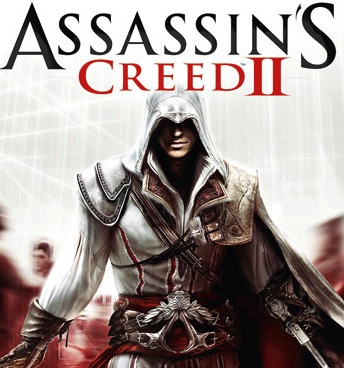
 Assassin’s Creed II has the honour of being the first game to be knocked off The Mantelpiece and into the velvet-lined, taffeter-embroidered bin labelled ‘Games That I’ve Completed This Year’. A rather nasty head cold earlier this month meant I was rendered incapacitated and unable to work for two days, but these rather phlegmy days and nights also gave me the chance to finish a couple of the excellent games that have been gathering dust on The Mantelpiece for far too long. (Enslaved was the other, rather brilliant game I had a chance to play, but more on that another time.)
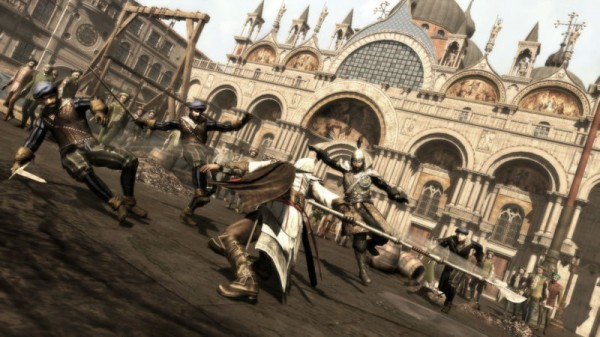
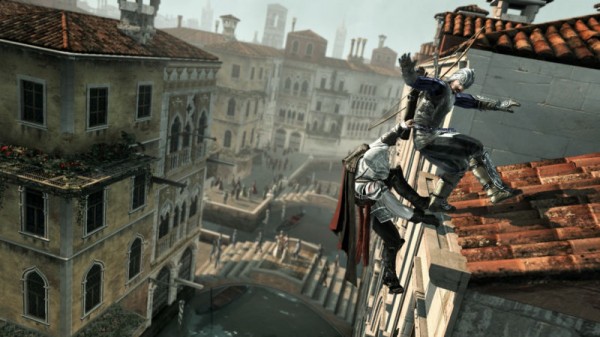
As an impetuous youth I was lucky enough to undertake a Grand Tour of Europe by train, and Northern Italy was easily the high point of my trip, so I was delighted to discover the astounding level of detail with which Florence and Venice have been recreated in Assassin’s Creed II. Playing the game, and in particular clambering up and down the beautiful Santa Maria del Fiore cathedral in Florence, brought back some very happy memories of my travels (not that I did much climbing on buildings when I was there, I tended to mostly appreciate them from ground level). As such, my enjoyment of the game was undoubtedly heightened by a sense of familiarity – that moment when you suddenly realise “Ah! I’ve been there!”. In a way it’s a bit like watching a movie that’s been filmed in your home town – your enjoyment of it is intrinsically linked to and heightened by the sense of familiarity and recgonition.
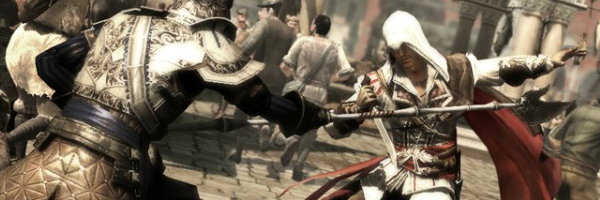
Gameplay wise, ACII is a big improvement on the original, and almost all of the annoying bits of the first game have either been expunged or tweaked. For instance, it’s now possible to fast travel between cities, and the extreme repetitiveness of the missions in the first game has been dealt with to some extent. I was a little bit disappointed with the optional assassination missions though – I was enjoying playing through the game so much, I decided to complete every optional mission in addition to those available through the main quest, but what did I receive for my troubles? Nothing. Zip. Nada. Not even an Achievement or an unlockable costume. Admittedly, I did quite enjoy playing through the various missions, but it seems a bit lazy on the developers’ part not to include at least some reward for trawling through every mission on offer.
One thing I was particularly grateful for was the disappearance of the much maligned flags from the previous game (see this article for my thoughts on such pointless collectibles), but sadly they’ve been replaced by some equally pointless feathers (although at least these are fewer in number). Speaking of pointless collectibles, I initially thought the inclusion of hidden treasure was neat touch, as it provided a collectible you could actually use to buy stuff with. However, I quickly realised that the income you received from upgrading your villa completely dwarfed the tiny amounts of cash you got from finding treasure, so looking for these collectibles also became rather pointless.
Another thing that continues to irritate me about the game (and its prequel) is the utterly ludicrous plot. If you’re unaware of the set-up, the idea is that a shadowy corporation have created a machine called the Animus that can unlock the ‘genetic memories’ of users and allow them to relive the lives of their ancestors. You play as Desmond Miles, whose rather murderous ancestors include the gleefully genocidal Altair (who you play in the first game) and the swarthy emo killer Ezio (who you play in this game and its sequel). From the get-go the plot dives into mystical mumbo-jumbo about the Knights Templar and powerful ancient artefacts that could destroy the world, and the second game happily turns the cliché-o-meter up to 11. Suddenly, Henry Ford, Hitler, Nikola Tesla and Adam and Eve are dragged kicking and screaming to the nonsensical unfoldings, until the game feels like a particularly poor episode of The X Files. Admittedly, the ending does provide a surprisingly effective moment when one of the characters breaks the fourth wall, but generally the ridiculous plot is an unwelcome addition to an otherwise excellent game about running around historical cities and murdering people in various inventive ways. Seriously, if they just chucked out all of the rubbish about ‘genetic memories’ and global conspiracies and just made a game where you played a historical assassin, the gameplay would not suffer in the slightest, and expunging the rather weak sections set in the modern day would actually improve matters.
Having said all that, I should emphasise at this point that despite my moaning, I really did enjoy the game enormously, and I’d highly recommend it. I even learned a bit about Rennaissance Italy, and surely there aren’t many games that you can say that about.
[As dictated by Lucius P. Merriweather]

 A MOST AGREEABLE PASTIME