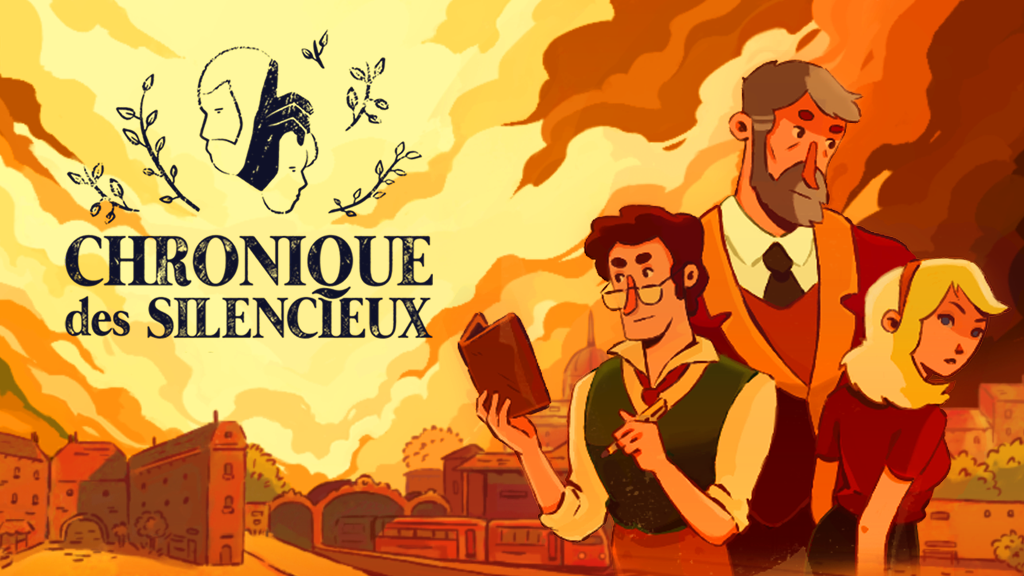
There’s no denying that Chronique des Silencieux is a real looker. The colourful artwork is superb, and the hand-drawn animated cut scenes are to die for. But these stunning looks hide a flawed and frustrating experience. The fact that it shows sparks of brilliance makes this all the more galling – I wanted to love this game, but it throws too many annoyances in the way.
Chronique des Silencieux is a hybrid between a point and click adventure and a detective game, which sees you play a teenager called Eugene arriving in the town of Bordeux after the death of his mother. He’s there to meet with his uncle Flavio, but it seems Flavio has got into a spot of trouble and is being held in the local police station. It soon transpires that Flavio is a pimp at a local brothel called Pays de Galles, which is run by the formidable Madame Solange, and Eugene soon meets with her and the working girls under her watch. It turns out Flavio is in jail for brawling with a local thug called One-Armed Hervé, and matters take a turn for the worse when Hervé turns up dead, and Flavio becomes a suspect. I should note here that the fact Hervé was murdered while Flavio was in jail doesn’t seem to provide enough of an alibi, which is the first sign that this game’s logic might not be entirely sound. Regardless, Eugene is now on a mission to uncover what’s been going on and attempt to free his uncle.

You do this in the classic point and click fashion of talking to absolutely everyone you can find, at the same time as picking up all sorts of scraps of paper and other odds and ends. The clever bit is that you can form connections between conversations and objects by dragging a beautifully animated piece of red string between them, with successful connections unlocking new paths of exploration. And I have to leap in here to say that this piece of string is probably the best thing in the entire game. I love how it jiggles about convincingly, and as a device for simulating reasoning, it’s utterly charming. String! Who knew it could be so wonderful.
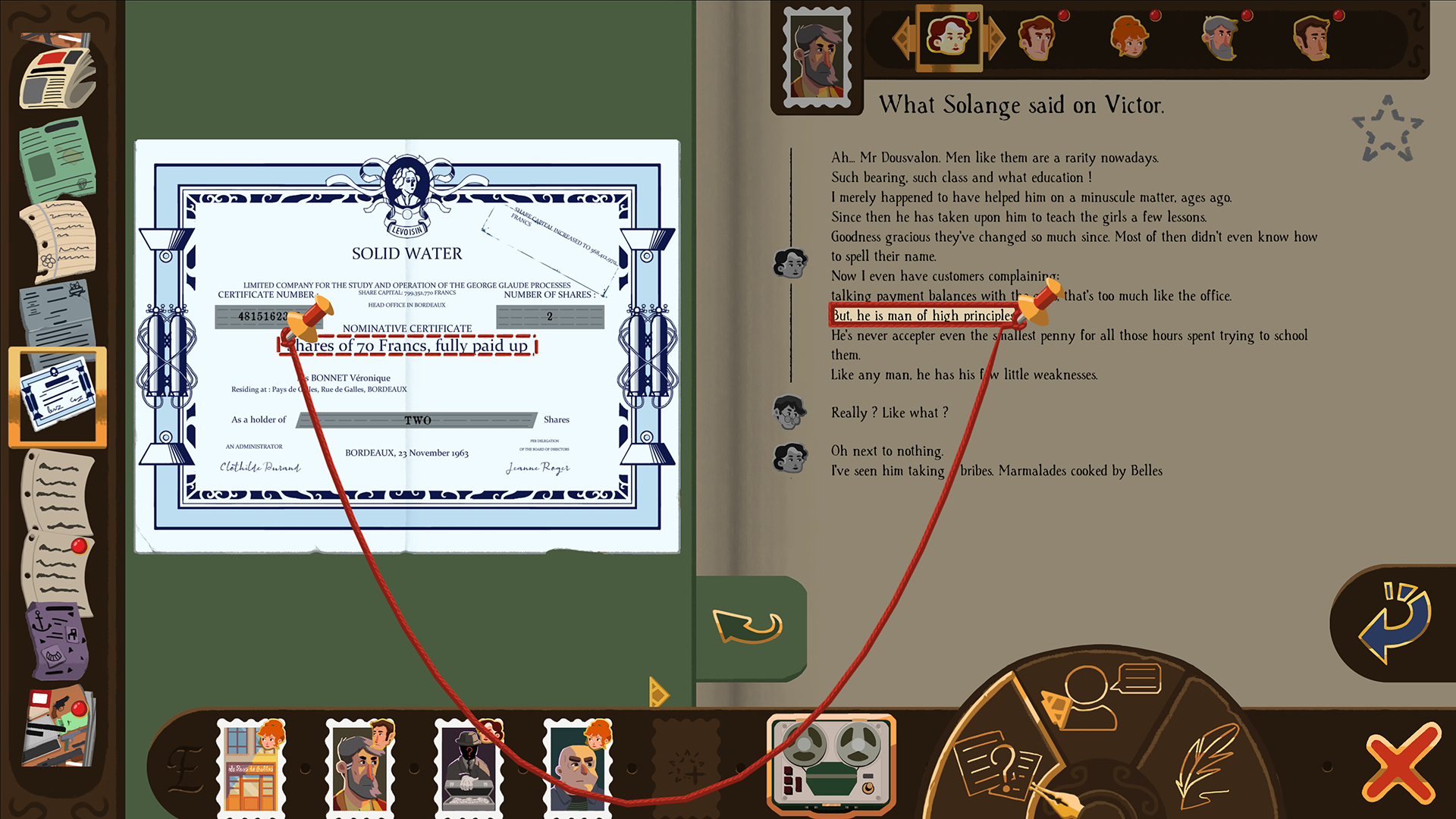
However, a less successful reasoning simulation is provided by padlocks. Early on, Madame Solange clams up, and her unwillingness to talk is represented by two locks, much like the ‘psylocks’ in the Ace Attorney games. To unlock these devices, you must place two characters or objects either side of the padlock, and then link them with a ‘key’, which takes the form of a verb like ‘Avenge’, ‘Kill’ or ‘Finance’, the idea being that you could make a supposition that so-and-so killed whathisname, or something along those lines.
In practice this just makes for a rather inelegant and frustrating interface, much like in the verb-based text adventures of old, where you might find yourself typing in things like ‘PICK UP STICK’, ‘GET STICK’, ‘GRAB OBJECT’ and then eventually realise that the game wanted you to specifically type ‘PICK UP POLE’. Likewise, in Chronique des Silencieux, I often found myself way ahead of Eugene in terms of my understanding of what was going on, yet trying to communicate that understanding to the game was often a case of trial and error.

Once you’ve managed to painstakingly prise open those padlocks, the prologue concludes with a lengthy session of deduction, where Madame Solange makes a number of statements, and then you have to connect these (with that lovely string) to conversations or objects you have gathered during your investigation. And this is where the game falls apart.
On the one hand, I appreciate the ambition of the developer, Pierre Feuille Studio. They have clearly been inspired by the Ace Attorney games to some extent, and they have attempted to address one key frustration with that series, which is that often the deduction feels too simplistic, merely a case of selecting a fairly obvious object from a meagre selection to link to an obviously related statement. At times this can feel a little trifling, perhaps even an insult to the player’s intelligence.

But on the other hand, the solution here goes to the other extreme, whereby you’re presented with pages and pages of conversations, along with a whole briefcase full of papers, each with numerous statements that can be individually selected. Then, on the other side, you have five possible statements from Madame Solange that can be linked to, plus only two attempts to get it right before the game chivvies you along to the next scene and deducts points from your end-of-chapter score. It’s nigh-on impossible, especially when there are many cases in which numerous different links could be plausible, or where the actual answer seems only vaguely related. I applaud the attempt to introduce some complexity, but it feels like this game was in desperate need of a ruthless editor to come in and trim down the options and text. It’s too much! As the old adage goes, sometimes less is more.
That sentiment extends to the prologue itself, which goes on for literally hours, only for the first chapter – the game proper – to begin some five years into the future. It wasn’t long after this that I finally gave up playing, after some five hours in total. I hit a brick wall in my investigations, seemingly exhausting all possible options early on in the chapter, and the game’s anaemic hint system stubbornly refused to provide any help.
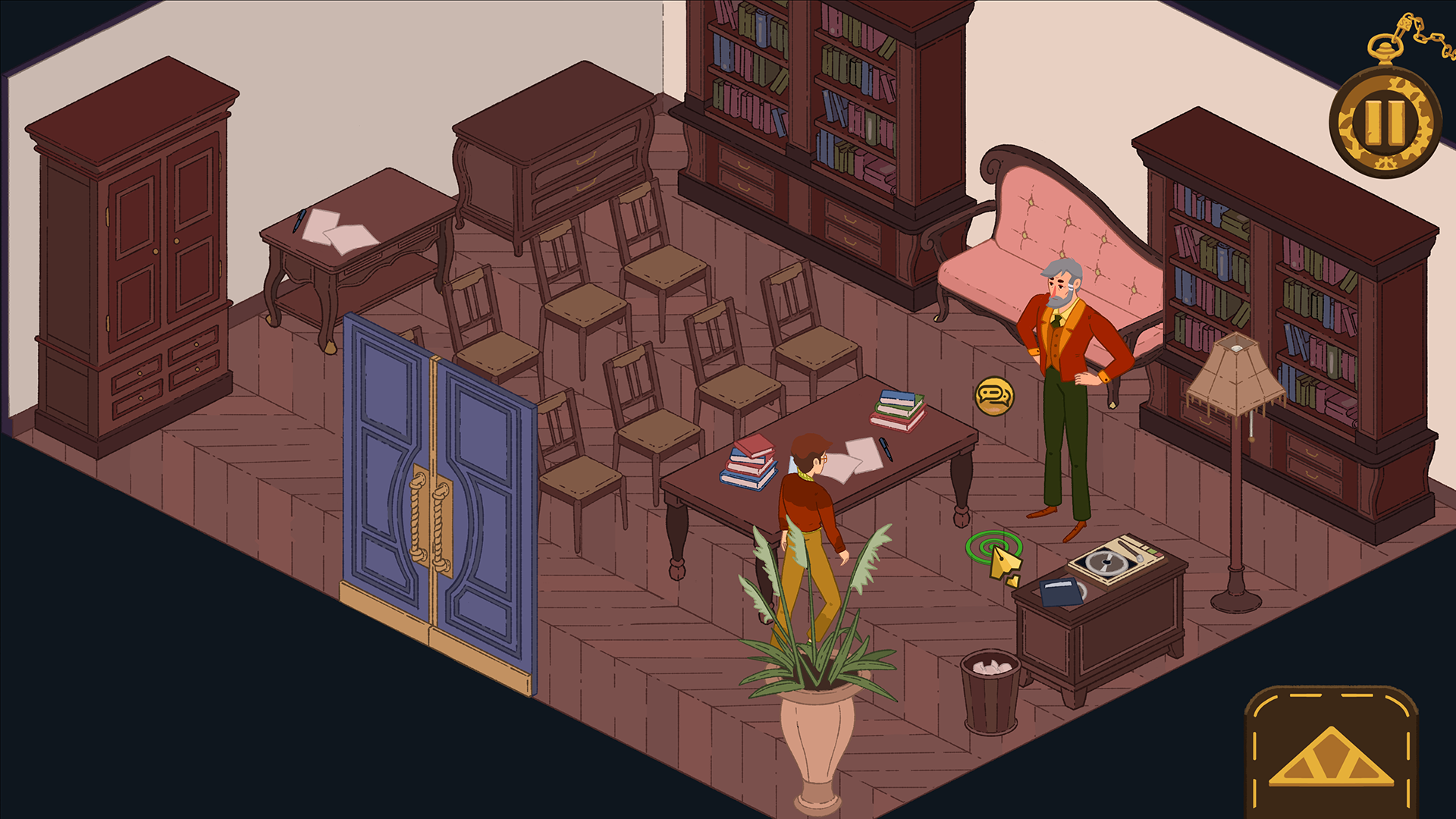
More to the point, I realised I wasn’t having much fun. In addition to the rather hit-and-miss deduction system, Chronique des Sliencieux throws all sorts of other annoyances in the player’s way, not least the fact that it takes forever to walk around the large and mostly empty town. This sort of problem was solved years ago in point and click adventures – like in The Excavation of Hob’s Barrow from 2022, which let you instantly move to any previously visited area – and it’s baffling that the developers haven’t done something similar here. In addition, the script is absolutely chock full of spelling mistakes and grammatical errors. I can forgive the odd mistake here and there, but for Chronique des Silencieux to have so many when the entire game is based around text just feels shoddy. Plus there are the bugs: I encountered various weird graphical anomolies on my playthrough, along with one full crash, although numerous hotfixes are being rolled out to address the bugs that are being raised.
It’s a shame, really. I found the characters in Chronique des Silencieux to be charming and interesting, and I genuinely wanted to see where the plot was going, with hints at a grander narrative as Eugene sets up on his own as a detective. The style, too, is sublime, with that colourful, characterful artwork and animation. But the flawed detective system, too ambitious for its own good, simply drained my goodwill for the game, and the many other annoyances completely sucked it dry.
Chronique des Silencieux was developed by Pierre Feuille Studio, and it’s available on PC.
Disclosure statement: review code for Chronique des Silencieux was provided by Strange Signals. A Most Agreeable Pastime operates as an independent site, and all opinions expressed are those of the author.
Follow A Most Agreeable Pastime on Twitter and Facebook, if you like.
 A MOST AGREEABLE PASTIME
Leave a Reply